
Squatters or a Tenant Who Won't Pay? Your Options in Pennsylvania
Pennsylvania changed its squatter law in 2024. Here's how removal works for someone who was never your tenant, the real timeline for evicting a tenant who stopped paying, the mistakes that backfire, and how to sell the house at any stage.
Published 10 min readSources checked and linked
In this guide
2024
Act 88: no notice to quit for someone who was never a tenant
10
days' notice to quit for unpaid rent
~40
days for the fastest nonpayment eviction, with no appeal
21
years of possession for adverse possession
Squatter, tenant or holdover? Why the label matters
The first question is who the person is, because that decides which process you use. Act 88 of 2024, signed July 17, 2024 and in effect since September 15, 2024, changed the definition of a tenant. A tenant now has to be living there with the owner's express or implied consent, which includes a written or oral lease, or the owner or an agent accepting rent. Someone who is not and never has been a tenant is owed no notice to quit, and the Landlord and Tenant Act doesn't apply to them.
| Who is in the house | How they got there | Process | Where |
|---|---|---|---|
| Squatter | Moved in without the owner's permission; never paid rent the owner accepted | Police (trespass) or an ejectment case | Local police, Court of Common Pleas |
| Tenant who stopped paying | Written or oral lease, or rent the owner accepted | Notice to quit, then a landlord-tenant complaint | Magisterial district court |
| Holdover | The lease ended and they stayed | Notice to quit, then a landlord-tenant complaint | Magisterial district court |
| Guest or relative who won't leave | Let in without a lease | Depends on the facts | Ask a Pennsylvania attorney first |
When police can help
Pennsylvania's criminal trespass law makes it a third-degree felony to enter, or secretly stay in, a building without permission, and a second-degree felony to break in. Staying after the owner personally tells someone to leave can be defiant trespass, a misdemeanor. There is a defense if the person reasonably believed the owner would have allowed them to be there, which is why a fake or disputed lease can stall things.
Whether officers act is up to them. Even before Act 88, the Pennsylvania Association of Realtors warned that "it may be difficult to convince the police to become involved." The bill's sponsor said squatters who stay where they aren't licensed or privileged commit defiant trespass, but the law did not create a special police removal process.
- Bring your deed or tax records and photo ID
- Bring proof there is no lease and you never accepted rent
- Tell the occupant in person, with officers present, to leave
- Ask officers for an incident number either way
Removing a squatter through ejectment
If police treat it as a civil matter, the owner files an ejectment action in the Court of Common Pleas, which is available when the occupant was never a tenant and refuses to leave. The Pennsylvania Association of Realtors puts the best case at an order around 30 days after the occupant is served, and more likely several months. Owners who hold the house in an LLC generally need a lawyer to file.
Evicting a tenant who stopped paying, step by step
Landlord-tenant cases go through the magisterial district court. Here is the order of events and the time each step takes under the court rules.
10 days
110 days
Serve a notice to quit
For unpaid rent the notice is 10 days. At the end of a lease or for other breaches it's 15 or 30 days, depending on the lease. A written lease can shorten or waive the notice. Serve it in person, at the property, or by posting it there.68 P.S. § 250.501
Hearing in 7–15 days
2Hearing in 7–15 days
File at the magisterial district court
The court sets a hearing 7 to 15 days after you file, and the complaint has to be served at least 5 days before it. Anyone else living there is warned they may be evicted too.Pa.R.Civ.P.M.D.J. 504, 506
Same day to 3 days
3Same day to 3 days
Hearing and judgment
The judge rules at the end of the hearing or within 3 days.Rule 514
10 days
410 days
Wait out the appeal window, then request possession
A residential tenant has 10 days to appeal (30 for a domestic violence victim who files the required affidavit). After the 10th day, and within 120 days of the judgment, you can request an order for possession.Rules 1002(B), 515
Within 48 hours
5Within 48 hours
The order is served
The sheriff or a certified constable serves the order within 48 hours of receiving it.Rules 516, 517
11 days after service
611 days after service
Lockout
On or after the 11th day after service, the officer can remove the tenant and any unauthorized occupant. In a case about rent only, the tenant can still pay the judgment and costs any time before the lockout and stay.Rules 518, 519
Total without an appeal: about 40 days at best (about 30 if the lease waives the notice), and often 6 to 9 weeks. An appeal with rent paid into escrow, the lesser of three months' rent or the rent owed and then monthly rent, can add months.
These are our estimates from the minimum and maximum times in the court rules, not a promise from any court.
| Local detail | What to know |
|---|---|
| Pittston court | Magisterial District 11-1-04, 35 Broad St., Pittston, 570-655-0552 |
| Archbald and Jessup court | Magisterial District 45-3-04, 400 Church St., 2nd floor, Archbald |
| 2026 filing costs | $102.50 for claims up to $2,000, $125.50 up to $4,000, $171 up to $12,000, plus service fees |
| Mediation | Since Oct. 1, 2025, districts may offer eviction mediation |
What not to do
Frustration is understandable, but these moves can turn a strong case into a lawsuit against you. The Attorney General's tenant guide is direct: landlord self-help eviction is prohibited.
- Changing the locks while someone is living there
- Shutting off heat, water or electricity to force them out
- Removing or throwing out their belongings
- Accepting money from a squatter
- Threats, or showing up with friends instead of police
- Waiting months before you act
Belongings left behind
For tenants, 68 P.S. § 250.505a sets the rules once an order for possession has been carried out or the tenant has otherwise abandoned the unit. The landlord must first send a written notice. The tenant then has 10 days from the postmark to take the items or ask that they be stored for up to 30 days, at the tenant's own cost. If there is a known protection-from-abuse order, the items are held 30 days. A written lease can set different terms, and violating the section can cost triple damages plus attorney fees.
For someone who was never a tenant, ask an attorney how to handle belongings before anything is thrown out.
Can a squatter end up owning your house?
Practically never. Adverse possession in Pennsylvania takes 21 years of "actual, continuous, exclusive, visible, notorious, distinct and hostile" possession, the standard the state Supreme Court repeated in December 2025. A narrow exception allows 10 years for a single-family home on half an acre or less that the claimant lived in the whole time, and it still requires a quiet title lawsuit.
Selling a house with a squatter or tenant in it
You don't have to finish the removal before you sell. A buyer takes on the seller's rights and duties, including any lease, and can continue the process after closing.
Under 68 P.S. § 250.104, a buyer has the same rights and duties as the seller. Hand over the lease, the rent history and the security deposit. Pennsylvania caps deposits at two months' rent in the first year and one month after that, and deposits must be returned or itemized within 30 days after a tenant leaves.
Finish the removal, then sell
- Most buyers
- Slowest
- Best for
- Owners who want the widest pool of buyers and can wait.
- Watch out
- Months of taxes, insurance and utilities if there's an appeal or an ejectment case.
Sell with the tenant and lease in place
- Investor buyers
- Best for
- A tenant who pays, or a problem that's close to resolved.
- Watch out
- The buyer inherits the lease and deposit, and a non-paying tenant scares most buyers off.
Negotiate a move-out
- Can be fastest
- Best for
- Quick resolution when the occupant is willing.
- Watch out
- Have an attorney draft it, and don't pay until they're out and the keys are back.
What we do
Sell as-is with the problem
- No lockout needed first
- Cash
- Your closing date
- Best for
- Owners who are done: out of town, out of patience, or out of money for the process.
- Watch out
- Our price accounts for the time and cost we take on, so compare our written offer with your other options.
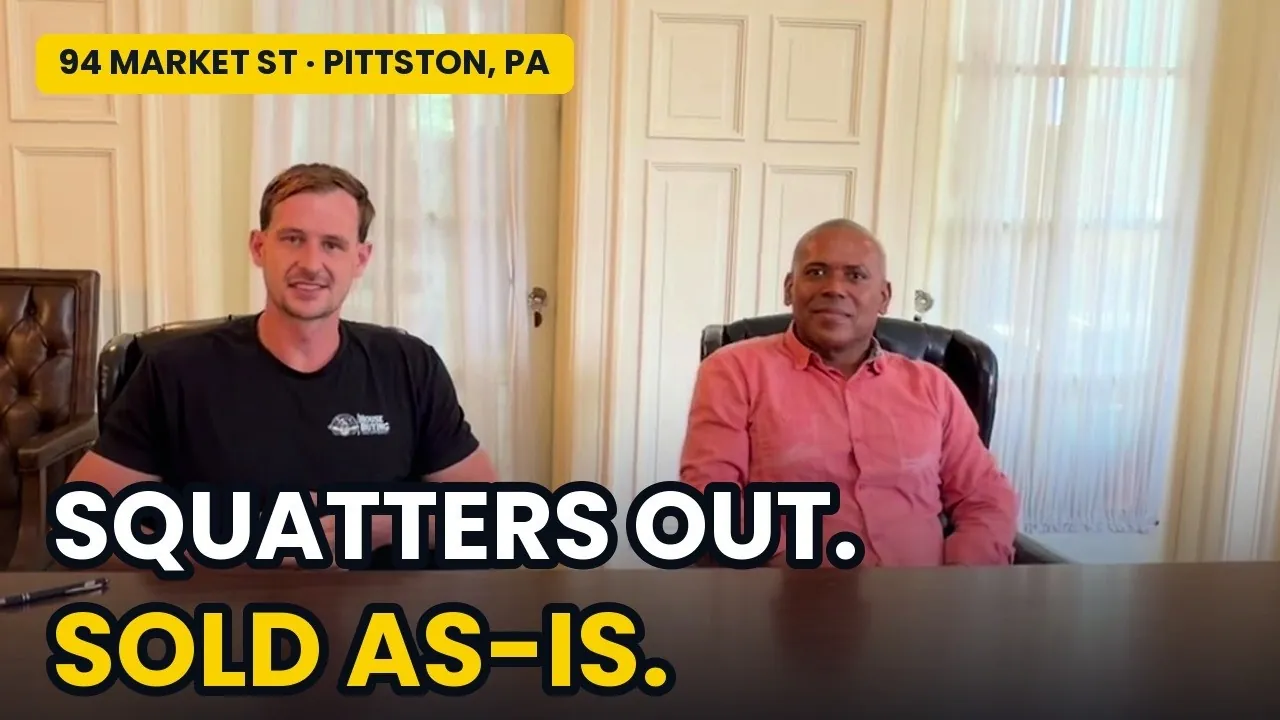
94 Market Street: occupant out, sold as-is
We bought this Pittston house in May 2026 knowing there had been an unauthorized occupant before closing and that the inside was rough. After we regained possession and finished the cleanout, our construction schedule was full, so we sold it as-is to Manny, a local buyer partner with his own renovation crew.
94 Market Street · Pittston, PA
We bought 94 Market Street in May 2026. Watch Part 1, our first look inside, on YouTube.
Questions owners ask
Can police remove a squatter in Pennsylvania?
Sometimes. Staying after the owner personally orders someone to leave can be defiant trespass, and entering or secretly staying in a building without permission can be criminal trespass. Officers decide whether to act. If they treat it as a civil matter, the owner's route is an ejectment action in the Court of Common Pleas.
Do I owe a squatter a notice to quit?
Not if the person never was your tenant. Since Act 88 of 2024 took effect on September 15, 2024, the Landlord and Tenant Act doesn't apply to someone who is not and never has been a tenant, and no notice to quit is required. Anyone with a lease, or whose rent you accepted, is a tenant and gets the full notice and court process.
How long does it take to evict a tenant who stopped paying?
About 40 days at best if nobody appeals, and often 6 to 9 weeks, counting the 10-day notice, the hearing, the 10-day appeal window and the 11 days after the order is served. An appeal with rent paid into escrow can add months.
Can I change the locks or shut off the utilities?
No. The Pennsylvania Attorney General's tenant guide says self-help eviction is prohibited, including changing locks or shutting off utilities to force someone out. The lockout is done by a sheriff or constable under an order for possession.
Can a squatter end up owning my house?
Practically never. Adverse possession in Pennsylvania takes 21 years of actual, continuous, exclusive, visible, notorious and hostile possession. A narrow exception allows 10 years for a single-family home on half an acre or less, and it still requires a court case.
What do I do with belongings a tenant leaves behind?
Send the written notice the law requires first. The tenant then has 10 days from the postmark to take the items or ask for up to 30 days of storage at their own cost. A written lease can change these terms, and getting it wrong can mean triple damages.
Can I sell a house with a tenant or squatter still inside?
Yes. A buyer steps into the seller's rights and duties, including any lease, and can continue the removal after closing. Many financed buyers won't buy an occupied problem house, which is why owners often sell to a cash buyer instead.
What happens to the lease and security deposit when I sell?
The lease carries over to the buyer. Give the buyer the lease, the rent history and the tenant's deposit. Pennsylvania caps deposits at two months' rent in the first year and one month after that, and deposits must be returned or itemized within 30 days after a tenant moves out.
Sources
Checked September 26, 2026. Laws, fees, programs and dates change, so confirm with the office listed before you rely on them.
- Act 88 of 2024 (SB 1236) · Justia
- Laughlin squatter legislation heads to the Governor · Pennsylvania Senate Republicans
- 18 Pa.C.S. § 3503, criminal trespass · Justia
- Removing unwanted occupants · Pennsylvania Association of Realtors
- Ejectment research guide · Jenkins Law Library
- Removing occupants: ejectment vs. eviction · CGA Law Firm
- 68 P.S. § 250.501, notice to quit · FindLaw
- Pa.R.Civ.P.M.D.J. 504 (hearing date) · Cornell Legal Information Institute
- Pa.R.Civ.P.M.D.J. 514 (judgment) · Cornell Legal Information Institute
- Pa.R.Civ.P.M.D.J. 515 (order for possession) · Cornell Legal Information Institute
- Pa.R.Civ.P.M.D.J. 519 (delivery of possession) · Cornell Legal Information Institute
- Pa.R.Civ.P.M.D.J. 1002 (appeal time) · Cornell Legal Information Institute
- Pa.R.Civ.P.M.D.J. 1008 (appeal and rent escrow) · Cornell Legal Information Institute
- Tenant and landlord guide · Pennsylvania Office of Attorney General
- 68 P.S. § 250.505a, tenant's property after eviction · FindLaw
- 42 Pa.C.S. § 5530, 21-year limit · Justia
- 42 Pa.C.S. § 5527.1, 10-year residential exception · FindLaw
- 68 P.S. § 250.104, rights of a buyer of leased property · FindLaw
- Understanding landlord-tenant law in Pennsylvania · North Penn Legal Services
- 68 P.S. § 250.511a and § 250.512, security deposits · FindLaw
- Magisterial district offices · Luzerne County
- Magisterial district judges · Lackawanna County
- 2026 magisterial district court cost table · Supreme Court of Pennsylvania
This guide is general information about Pennsylvania law, not legal advice. Removing an occupant has real legal risk, so talk with a Pennsylvania landlord-tenant attorney about your situation before you act.
Statute text was read on public legal databases and should be confirmed against the official Pennsylvania code. Court fees and rules change; confirm them with the magisterial district court.
Keep reading
More Northeast PA seller guides
Related local pages
Local, direct, no obligation
Sell the house, tenants and all
We buy houses in Northeast PA with squatters, non-paying tenants or a half-finished eviction, and we handle what comes next after closing.